Salary transparency reality
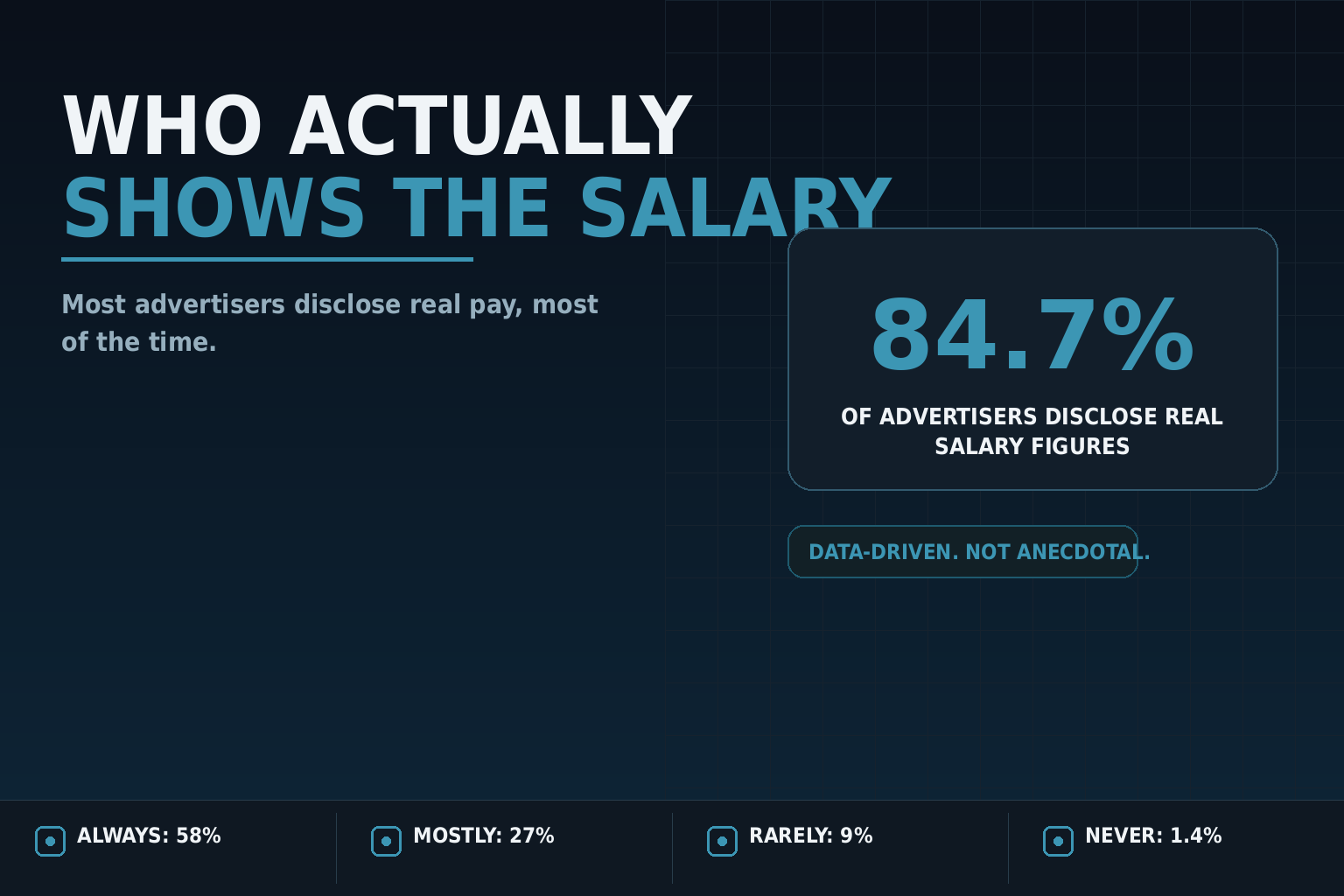
"Competitive salary" is rarer than you think. We checked 7,750 employers to prove it.
We checked how many job ads actually include a salary.
The answer surprised us.
So why does it still feel like nobody shares salaries?
A few possibilities worth holding in mind: the non-disclosers may be concentrated among a small number of high-volume posters rather than evenly spread, so they shape your impression of the whole market even though they're not representative of it. Salary disclosure norms also differ sharply by seniority, sector, and region — an aggregate average hides a lot of variation. And "includes a number" isn't the same as "includes a useful number" — a wide, vague band technically counts as disclosure but doesn't help you evaluate the role much better than no number at all.
✅ Always discloses
57.9% of advertisers include a real salary figure on every posting.
👍 Mostly discloses
A further 26.8% include salary on 75–99% of their postings.
🚫 Never discloses
Just 1.4% of advertisers withhold salary across every posting — the real minority.
🎯 What this means for your search
If you're weighing whether to apply to a role with no salary listed, it's reasonable to ask for a range early — most employers and agencies are used to the question, and disclosure is the norm, not the exception, in our data. An advertiser who consistently withholds salary across many postings, when most of their peers don't, is worth treating as a minor yellow flag rather than the default expectation.
See who actually discloses pay
GetJobzi tracks salary-transparency behaviour per advertiser as part of a fuller trust picture.
👉 GetJobzi.com — Register for free